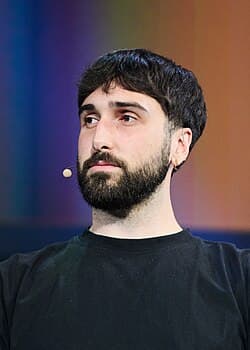
Aidan Gomez
Co-founder and CEO, Cohere
A Transformer co-author who moved from foundational language-model research to building enterprise AI through Cohere.
Biography
Aidan Gomez is a computer scientist and entrepreneur whose career began in machine-learning research and developed into the leadership of an AI company. He studied computer science at the University of Toronto and later completed a doctorate at the University of Oxford in 2024. His research interests developed during a period of rapid progress in neural approaches to language.
While working at Google as an intern, Gomez co-authored Attention Is All You Need, the 2017 paper that introduced the Transformer architecture. The paper described an approach based on attention mechanisms rather than recurrent or convolutional sequence processing. Its architecture became a major foundation for later language models, although the subsequent field involved many additional advances and contributors.
In 2019, Gomez co-founded Cohere with Nick Frosst and Ivan Zhang. As CEO, he leads a company focused on language models and related tools for enterprise use. Cohere’s work connects model development with organizational requirements such as information retrieval, deployment choices, and the use of AI within existing business systems.
Gomez’s profile therefore spans both a specific foundational research contribution and the broader work of building a commercial AI organization. His experience illustrates a path from collaborative academic and industrial research to product development. At Cohere, the emphasis is on making language technology useful in practical workflows rather than treating a model’s research performance as the endpoint.
Notable contributions
Co-authored the Transformer paper
Was one of eight authors of Attention Is All You Need, which introduced an attention-based architecture without the recurrent layers used in many earlier sequence models.
Co-founded Cohere
Co-founded Cohere with Nick Frosst and Ivan Zhang in 2019 to build language model technology and make it available to organizations.
Led enterprise language model development
Leads Cohere’s work on models and tools intended for enterprise use, including language generation and retrieval-based applications. This is an organizational leadership contribution.