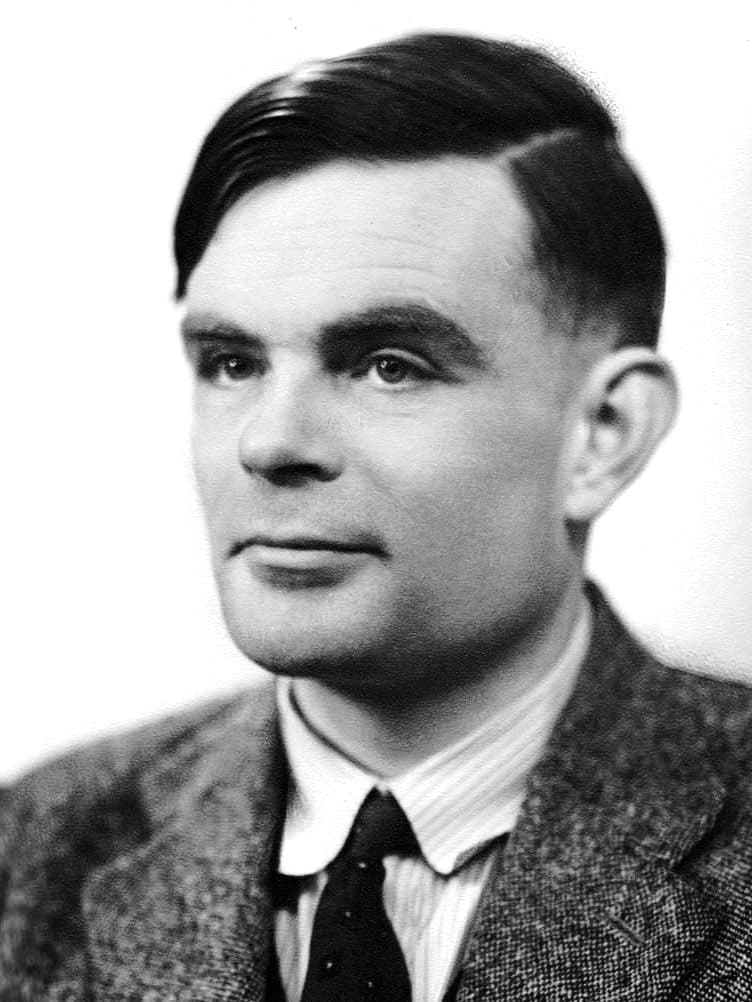
Alan Turing
A mathematical pioneer whose ideas about computation and evaluating machine intelligence continue to frame AI research.
Biography
Alan Turing was a British mathematician whose work provided a foundation for theoretical computer science. He studied mathematics at King's College, Cambridge, and earned his doctorate at Princeton University in 1938. His research asked what a mechanical procedure could compute, connecting abstract mathematical questions with the possibilities of general-purpose machines.
In 1936, Turing described the model now called a Turing machine. It offered a precise way to discuss algorithms and the limits of computation. The importance of the work was not a particular physical device, but a mathematical account of how a simple machine could execute procedures and represent general computation.
During the Second World War, Turing contributed to codebreaking at Bletchley Park. Afterward, he worked on early computer designs at the National Physical Laboratory and on computing at the University of Manchester. His 1950 paper Computing Machinery and Intelligence introduced an imitation-game approach to discussing whether machines could exhibit intelligent behavior.
Turing also investigated mathematical biology before his death in 1954. His connection to AI rests on the conceptual groundwork for programmable computation and on a lasting question about how machine intelligence should be evaluated. His historical significance predates AI's naming as a discipline and should not be confused with direct involvement in contemporary learning architectures.
Notable contributions
Formalized a general model of computation
Introduced the mathematical machine model now used to define computability and reason about algorithms.
Proposed the imitation game
Presented an influential behavioral framing for evaluating machine intelligence in Computing Machinery and Intelligence.
Contributed to early computer design
Developed the Automatic Computing Engine proposal during his work at the National Physical Laboratory.