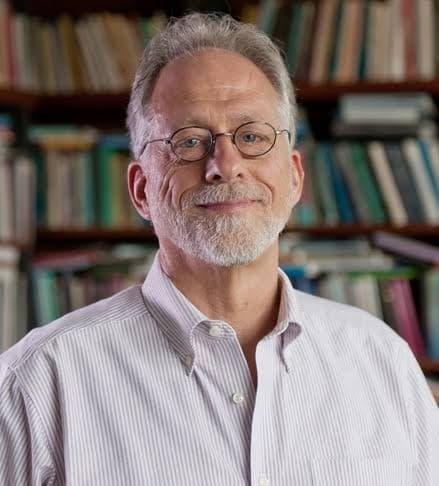
David Rumelhart
A cognitive scientist whose collaborative work on distributed representations and backpropagation shaped neural-network research.
Biography
David Rumelhart was an American cognitive scientist who studied how people represent information and learn. He earned an undergraduate degree at the University of South Dakota and a doctorate in mathematical psychology at Stanford University in 1967. His academic career included the University of California, San Diego, and later Stanford.
Rumelhart helped develop the connectionist approach to cognition, in which interacting units and distributed representations could model aspects of mental activity. With James McClelland and collaborators, he edited Parallel Distributed Processing in 1986. The project brought together theories and computational models addressing learning, memory, language, and other cognitive processes.
In the same year, Rumelhart co-authored Learning representations by back-propagating errors with Geoffrey Hinton and Ronald Williams. The paper demonstrated the use of error propagation to train internal representations in multilayer networks. Backpropagation had earlier antecedents, so the contribution is best understood as influential development and demonstration rather than an exclusive invention of the entire method.
Rumelhart received a MacArthur Fellowship in 1987 and continued his academic work at Stanford before retiring. He died in 2011. His legacy connects cognitive science with machine learning: ideas about distributed processing helped make neural models a serious framework for studying both human cognition and computational learning, well before their later expansion through large datasets and computing systems.
Notable contributions
Co-authored influential backpropagation research
Demonstrated learning of internal representations in multilayer neural networks with Geoffrey Hinton and Ronald Williams.
Co-edited Parallel Distributed Processing
With James McClelland and collaborators, developed a major connectionist account of cognition.
Received a MacArthur Fellowship
Recognized for his contributions to cognitive science.