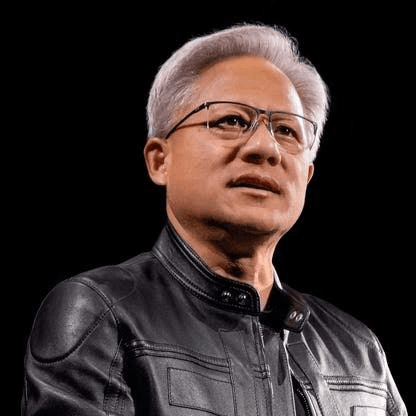
Jensen Huang
Co-founder, President and CEO, NVIDIA
NVIDIA’s co-founder helped make accelerated computing a foundation for modern AI training, inference, and data-center infrastructure.
Biography
Jensen Huang is an electrical engineer and entrepreneur who co-founded NVIDIA in 1993 with Chris Malachowsky and Curtis Priem. Born in Taiwan and educated in the United States, he earned an undergraduate engineering degree at Oregon State University and a master’s degree at Stanford University. Before founding NVIDIA, he worked in the semiconductor industry at AMD and LSI Logic.
NVIDIA initially focused on graphics processors, building hardware for the increasingly demanding visual workloads of personal computers and games. Huang’s long-term leadership extended that business into a wider model of accelerated computing. The company’s CUDA platform, introduced in 2006, made its GPUs accessible for general-purpose parallel computation rather than graphics alone.
That hardware and software combination became especially important to deep learning. Training neural networks involves large amounts of repeated numerical computation, and GPU acceleration helped researchers run experiments at a scale that would otherwise be difficult. NVIDIA subsequently expanded its offerings to include data-center systems, networking, software libraries, and tools for AI deployment.
Huang’s significance in AI lies in infrastructure and business leadership. He did not originate the field’s central learning algorithms, but he directed a company whose products became widely used to develop and operate them. His work links semiconductor design, software ecosystems, and the practical computing requirements of research laboratories and commercial AI services.
Notable contributions
Co-founded NVIDIA
Established NVIDIA in 1993 and has served as president and CEO since its founding. The company became a major provider of accelerated computing systems.
Built an organization behind CUDA
Led NVIDIA as it introduced CUDA in 2006, enabling developers to program GPUs for general-purpose computing, including later deep learning workloads.
Expanded GPU computing for AI
Directed NVIDIA’s expansion from graphics hardware into platforms used to train and run neural networks, combining processors, networking, software, and systems.