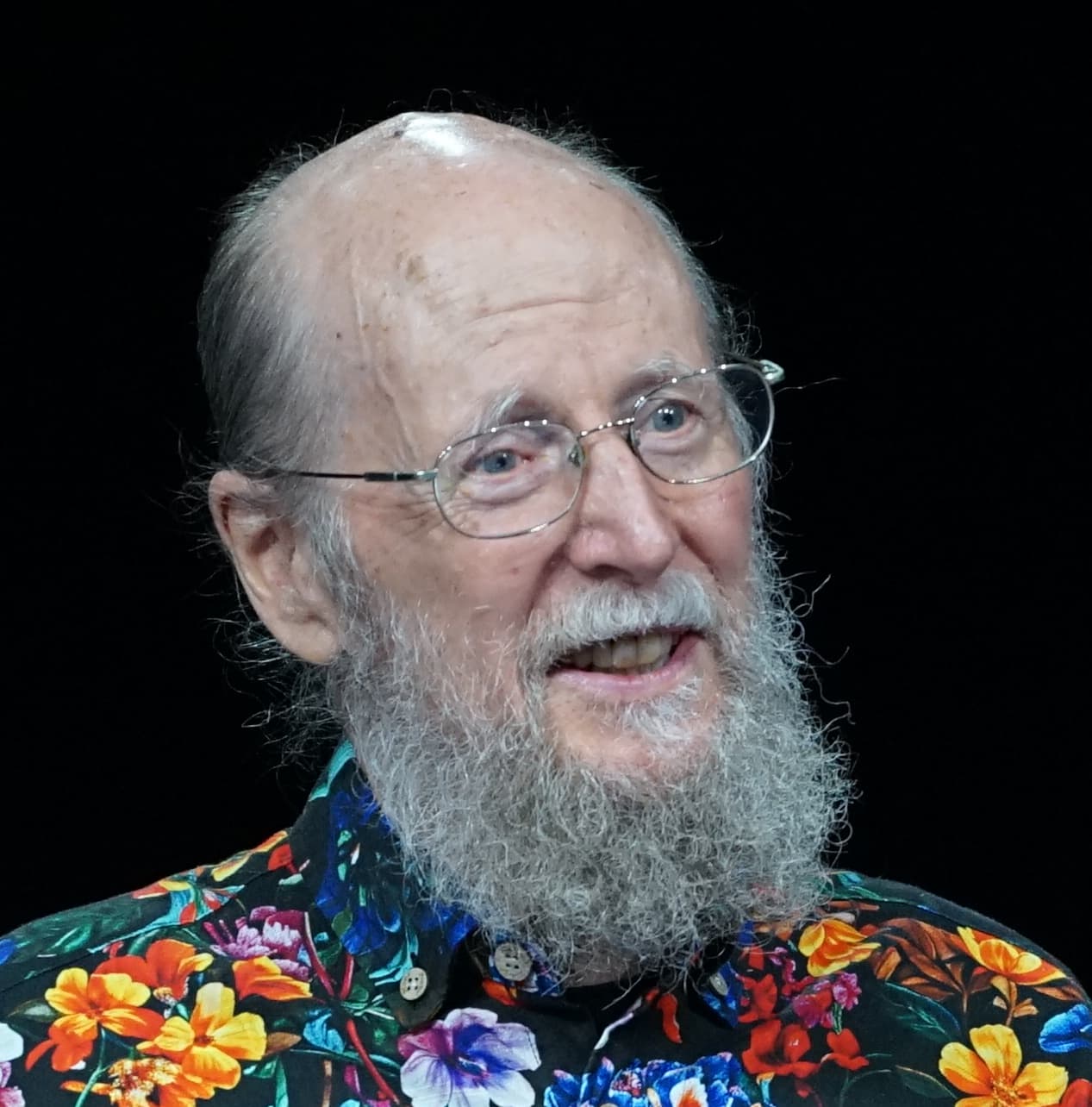
Richard Sutton
Professor of Computing Science at the University of Alberta
A reinforcement-learning pioneer focused on agents that improve through experience rather than relying only on fixed training datasets.
Biography
Richard Sutton is a computer scientist whose research helped establish modern reinforcement learning. He earned a psychology degree at Stanford University and completed graduate study in computer science at the University of Massachusetts Amherst, receiving his doctorate in 1984 under Andrew Barto. That combination connected questions about learning behavior with mathematical and computational models.
Sutton developed influential temporal-difference methods, which update predictions using the difference between successive estimates. These methods made it possible for an agent to learn from experience before the final outcome of an interaction was known. His research also contributed to the broader treatment of value functions, policies, and learning over time.
With Barto, he wrote Reinforcement Learning: An Introduction, first published in 1998 and substantially updated in 2018. The book helped establish a common vocabulary for the field. His later essay The Bitter Lesson argued that general methods able to benefit from increased computation often outperform approaches built around detailed human knowledge of a particular task.
Sutton has been a professor at the University of Alberta and a scientific adviser at the Alberta Machine Intelligence Institute. He and Barto received the 2024 ACM A. M. Turing Award, announced in 2025. His continuing research emphasizes learning from interaction and experience, a direction represented in the work published by Oak Lab.
Notable contributions
Developed temporal-difference learning
Established influential prediction methods that learn from successive estimates and experience.
Co-authored Reinforcement Learning: An Introduction
Created a foundational textbook with Andrew Barto; a second edition appeared in 2018.
Shared the 2024 ACM Turing Award
Recognized with Andrew Barto for the conceptual and algorithmic foundations of reinforcement learning.