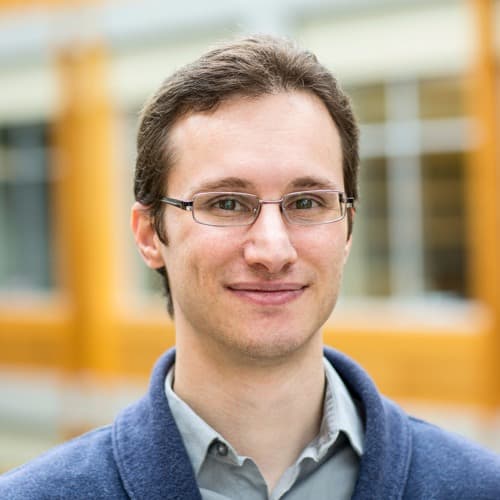
Sergey Levine
Professor at UC Berkeley; Co-founder of Physical Intelligence
A researcher in reinforcement learning and robotic control whose work explores how machines can learn actions directly from observations and data.
Biography
Sergey Levine is a computer scientist at the University of California, Berkeley, working on machine learning for decision-making and control. He received bachelor’s, master’s, and doctoral degrees in computer science from Stanford University, completing his doctorate in 2014. He joined Berkeley’s faculty in 2016.
His research combines deep learning with reinforcement learning to help robots acquire skills from interaction and recorded experience. He co-authored End-to-End Training of Deep Visuomotor Policies, which investigated learning robotic control from visual inputs. This work connected perception and action within a learned policy rather than treating them as entirely separate hand-engineered components.
Levine’s broader research includes methods for learning from existing datasets and scaling robotic learning across tasks. He is also a co-founder of Physical Intelligence, connecting this research direction with the development of general-purpose robotic systems. His contribution centers on the algorithms and data-driven methods that allow agents to act in the physical world, where observations are incomplete and mistakes have practical consequences.
Notable contributions
Co-authored end-to-end visuomotor learning research
Investigated jointly learned visual perception and robotic control policies.
Co-founded Physical Intelligence
Helped establish a company focused on AI for general-purpose robotic behavior.