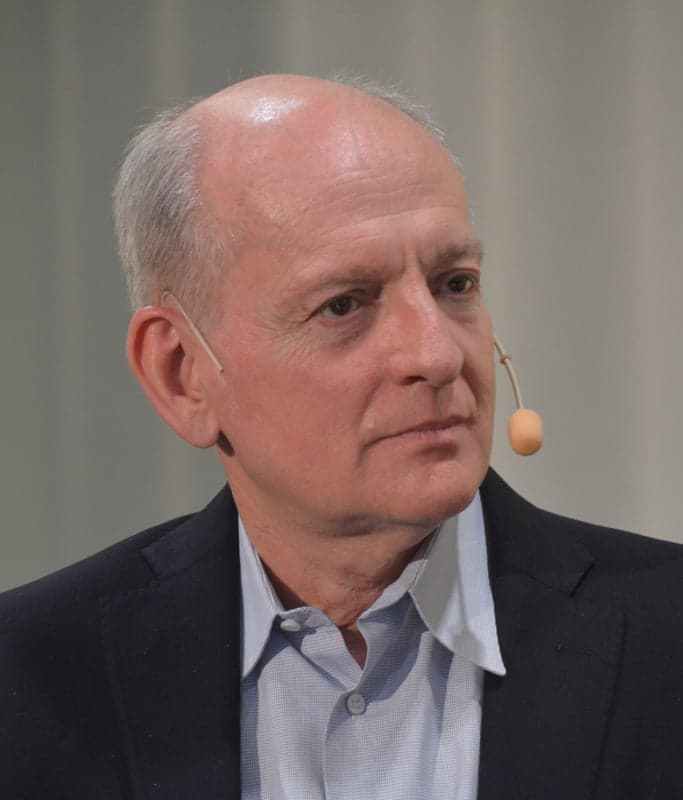
Stuart Russell
Professor of computer science at UC Berkeley
A Berkeley professor and co-author of the standard AI textbook, who argues that advanced AI must be built to defer to human preferences.
Biography
Stuart Russell is a British computer scientist and professor of computer science at the University of California, Berkeley. Born in Portsmouth, England, he studied physics at Wadham College, Oxford, and completed a PhD in computer science at Stanford University in 1986. He joined the Berkeley faculty afterwards and, from 2008 to 2011, also held an adjunct appointment in neurological surgery at UC San Francisco, working on computational physiology and intensive-care monitoring.
His research spans machine learning, probabilistic reasoning, knowledge representation, planning and inverse reinforcement learning. With Peter Norvig he wrote Artificial Intelligence: A Modern Approach, a textbook used by more than 1,500 universities in 135 countries. In 2016 he founded the Center for Human-Compatible Artificial Intelligence at Berkeley, and his 2019 book Human Compatible argues for AI systems that remain uncertain about human preferences. He has also campaigned against autonomous weapons, gave the BBC's 2021 Reith Lectures, and signed several open letters on AI risk.
Notable contributions
Co-authored Artificial Intelligence: A Modern Approach
With Peter Norvig, wrote the textbook first published in 1995 that became the leading university text in the field, used by more than 1,500 universities in 135 countries.
Founded the Center for Human-Compatible AI
Founded the Center for Human-Compatible Artificial Intelligence at UC Berkeley, with co-principal investigators including Pieter Abbeel, Anca Dragan and Tom Griffiths, to research AI systems that stay aligned with human values.
Published Human Compatible
Wrote Human Compatible: Artificial Intelligence and the Problem of Control, a book arguing that AI should be designed to pursue human preferences it is uncertain about rather than fixed objectives.
Received the IJCAI Award for Research Excellence
Won the 2022 IJCAI Award for Research Excellence, becoming only the second person to hold both of the conference's main research awards after the 1995 Computers and Thought Award.